Introduction to Sidereal and Tropical Astrology
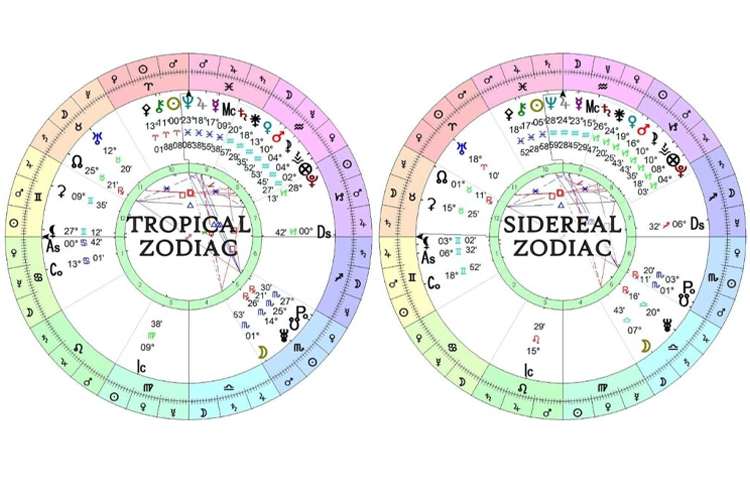
Sidereal and Tropical astrology are two major zodiac systems used to calculate planetary positions and interpret birth charts. While both divide the zodiac into twelve signs of 30 degrees each, the key difference lies in their reference points. Tropical astrology is aligned with the Earth’s seasonal cycle, while Sidereal astrology is aligned with the actual constellations in the sky.
This difference developed because of a slow astronomical phenomenon called the precession of the equinoxes, which causes the Earth’s axis to shift gradually over time. As a result, the zodiac signs in the two systems no longer perfectly overlap. Both systems are valid within their own traditions and philosophical foundations.
Origin and Historical Development
Tropical astrology developed primarily within the Greek and Western tradition. It was formalized by scholars such as Claudius Ptolemy, who structured astrology around the seasonal equinoxes and solstices. The system begins at 0° Aries during the Spring Equinox, making it season-based rather than constellation-based.
Sidereal astrology traces its roots to ancient Indian astronomy and is preserved in Vedic Astrology. This system calculates planetary positions according to the fixed stars and adjusts for precession. Over time, these two traditions evolved separately, forming distinct interpretative methods.
- Tropical rooted in Greek-Western tradition
- Sidereal rooted in Indian-Vedic system
- Tropical tied to equinox cycle
- Sidereal tied to fixed constellations
Astronomical Foundation and Calculation
The Tropical zodiac is anchored to the Earth’s seasonal cycle. It starts with the Spring Equinox, meaning 0° Aries always aligns with the beginning of spring in the Northern Hemisphere. It does not adjust for the gradual backward shift of constellations caused by precession.
The Sidereal zodiac measures planetary positions against the actual background of fixed stars. It includes an adjustment factor called “ayanamsa” to account for precession. Because of this correction, Sidereal planetary placements are typically about 23–24 degrees behind Tropical placements.
- Tropical based on seasonal cycle
- Sidereal based on fixed star positions
- Sidereal uses ayanamsa correction
- Zodiac signs shift differently in each system
Philosophical Approach and Interpretation
Tropical astrology emphasizes psychology, personality traits, and inner development. It focuses on how planetary energies influence character, emotions, and life themes. This approach is widely used in modern Western horoscope readings.
Sidereal astrology places stronger emphasis on karma, destiny, and concrete life events. It often includes predictive techniques such as planetary periods (dashas) and divisional charts. The approach is more event-oriented and spiritually grounded.
- Tropical focuses on personality analysis
- Sidereal focuses on karma and destiny
- Western astrology uses Tropical system
- Vedic astrology uses Sidereal system
Impact on Zodiac Signs and Birth Charts
Due to the difference in calculation, a person’s Sun sign may change when switching between Tropical and Sidereal systems. For example, someone considered an Aries in Tropical astrology might be a Pisces in Sidereal astrology. This shift often surprises people when they compare charts.
However, the overall personality interpretation depends on the complete birth chart, not just the Sun sign. Both systems provide meaningful insights when applied correctly within their own framework.
- Sun sign may shift between systems
- Entire birth chart must be analyzed
- Difference caused by precession
- Interpretations vary by tradition
Modern Usage and Global Practice
Today, Tropical astrology dominates in Western countries and popular horoscope columns. It is widely used in psychological astrology and self-development practices.
Sidereal astrology remains central to Indian astrology and is deeply integrated into cultural practices such as marriage matching, naming ceremonies, and auspicious timing. With globalization and digital chart tools, both systems are now accessible worldwide, allowing individuals to explore and compare interpretations.
- Tropical popular in Western media
- Sidereal central to Vedic practice
- Both systems available online
- Used for personal and predictive guidance