Introduction
Tajik Yogas are special planetary combinations used in the Varshaphal (Annual Horoscope) system of astrology. Unlike traditional Vedic yogas found in the natal chart, Tajik Yogas are specifically applied for yearly predictions and are based mainly on planetary aspects and their applying or separating motion. These yogas originate from the Tajika system, which emphasizes dynamic interactions between planets during the year.
The core principle behind Tajik Yogas is whether planets are moving toward each other (applying aspect) or moving away (separating aspect). This movement determines whether an event will materialize, face delay, or fail to produce expected results. Therefore, Tajik Yogas are essential tools for understanding the success, timing, and outcome of yearly events.
Foundation of Tajika Aspect Theory
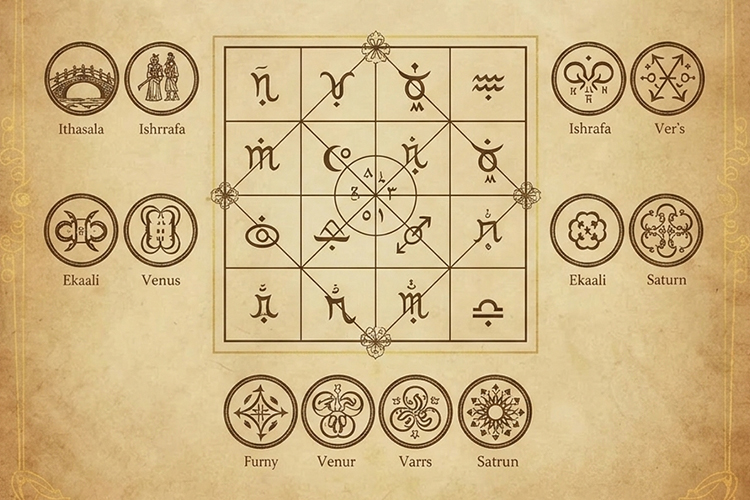
The Tajika system gives primary importance to aspects rather than just house placement. It recognizes specific angular relationships between planets and studies whether they are forming an applying connection. An applying aspect suggests that energy is building and events are likely to manifest.
If planets are separating, it may indicate missed opportunities, delays, or weakening of results. The speed of planets also plays a crucial role, as faster planets applying toward slower planets create stronger event potential. This dynamic approach makes Tajik Yogas highly predictive for short-term outcomes.
- Focuses on planetary aspects
- Applying aspect indicates manifestation
- Separating aspect shows decline
- Planetary speed influences results
Ithasala Yoga – Yoga of Fulfillment
Ithasala Yoga is one of the most significant Tajik Yogas and is formed when two planets are moving toward conjunction or aspect within close degrees. It indicates that a matter under consideration is likely to be fulfilled successfully during the year.
This yoga often signifies progress, agreements, achievements, and completion of pending tasks. However, the nature of results depends on the houses ruled and occupied by the involved planets. Benefic planets create smoother success, while malefic involvement may bring achievement through struggle.
- Formed by applying aspect
- Indicates success and fulfillment
- Promises completion of efforts
- Results depend on planetary nature
Isarpha Yoga – Yoga of Separation
Isarpha Yoga is formed when planets are separating from each other after forming an aspect. This indicates that the opportunity has either passed or the matter may not yield expected results. It often suggests delays, disappointment, or incomplete efforts.
This yoga does not always mean failure but shows reduced momentum. If supported by other strong combinations, the matter may still progress slowly. Therefore, Isarpha requires careful interpretation alongside other chart factors.
- Formed by separating aspect
- Indicates delay or missed opportunity
- Shows weakening momentum
- Needs supportive combinations for success
Nakta and Yamaya Yogas – Hidden and Indirect Outcomes
Nakta Yoga is formed when two planets do not aspect each other directly but connect through a third intermediary planet. It indicates indirect fulfillment or hidden developments behind the scenes. Matters may progress quietly without immediate visibility.
Yamaya Yoga occurs when there is a chain-like planetary interaction influencing results indirectly. These yogas suggest that events may unfold in unexpected ways or through external support rather than direct effort.
- Indirect planetary connections
- Hidden or behind-the-scenes progress
- Results may come unexpectedly
- Requires detailed aspect analysis
Manahoo and Kamboola Yogas – Strength and Weakness Indicators
Manahoo Yoga is formed when malefic planets influence an otherwise positive Ithasala Yoga. This can reduce or obstruct the promised success. It indicates that although fulfillment is possible, obstacles and stress may accompany it.
Kamboola Yoga, on the other hand, strengthens Ithasala by adding supportive planetary influence, especially from benefics. It enhances prosperity, harmony, and ease in achieving goals. These yogas refine predictions by modifying primary combinations.
- Manahoo weakens positive results
- Kamboola strengthens fulfillment
- Shows quality of event outcome
- Important for result modification
Practical Role of Tajik Yogas in Annual Predictions
Tajik Yogas are central to determining whether specific events will occur during the year. They help astrologers judge the likelihood of marriage, career changes, financial gains, travel, agreements, or disputes. Without analyzing Tajik Yogas, annual predictions may lack timing accuracy.
By studying applying aspects, planetary dignity, house rulership, and supporting combinations, astrologers can predict not only what may happen but also how smoothly it will unfold. Tajik Yogas therefore provide depth, precision, and clarity to Varshaphal interpretation.
- Essential for event confirmation
- Improves timing accuracy
- Indicates smooth or difficult progress
- Core technique in Varshaphal analysis